Nutrixe
Lentils contain no gluten: they are pulses, like split peas, beans, chickpeas and broad beans. But wheat and barley grains can slip in between the field and the bag, and studies have found them. That’s why coeliac associations advise sorting and rinsing dried lentils, and why so many bags warn of traces of gluten.
Pulses, not cereals
Lentils, peas, beans and broad beans belong to a different botanical family from wheat, barley and rye, and their proteins don’t trigger the coeliac reaction. Coeliac UK lists pulses (peas, beans, lentils) among foods suitable for a gluten-free diet; French coeliac association AFDIAG counts them among naturally gluten-free foods; the Italian coeliac association (AIC) allows all pulses, fresh, frozen, dried or tinned, as long as they contain nothing but water, salt and a few simple ingredients.
So the problem isn’t the lentil. It’s what travels with it.
Wheat grains in the bag
Lentils are harvested, stored and sorted in supply chains that also handle wheat and barley. A cereal grain can get mixed in from the field onwards and slip through sorting: that’s the explanation favoured by the authors of the Italian study below.
Two studies have measured it:
- In Italy, a team from the Polytechnic University of Marche analysed 200 gluten-free products, gluten free by nature or by label, bought in supermarkets in 2016. 4 of 17 lentil products were above 20 mg/kg of gluten, against none of 6 chickpea products and none of 7 kidney bean products. None of those lentil packs was labelled “gluten free”. The authors report that patients find occasional wheat grains when sorting their lentils, and recommend inspecting and washing them.
- In the United States, 25 bags of dried lentils from 24 brands, bought in 2021, were sorted by hand. Two contained cereal grains: a grain of wheat in one 454 g (16 oz) bag, a grain of wheat and a grain of barley in another. The authors calculate that at 20 mg/kg, a food should contain no more than 2 intact grains per kilo, or one grain per 500 g: a single grain in a 454 g bag is enough to exceed the “gluten free” threshold.
The habit that protects you: sort, then rinse
Unlike a flour, where contamination spreads through the powder, a wheat grain in lentils stays whole and visible. The AIC draws a reassuring conclusion: for dried pulses, a visual check, removing foreign grains and then rinsing “amply protect” a person with coeliac disease. AFDIAG also recommends rinsing lentils well before eating them.
In practice:
- Spread the lentils on a light-coloured plate and remove anything that isn’t a lentil: elongated grains, small stones, debris.
- Rinse them under running water in a sieve to wash away dust.
- For red lentils and split peas, hulled and split, sorting by eye is harder: a “gluten free” bag spares you the job.
This habit doesn’t work for pulse flours (lentil flour, chickpea flour) or lentil pasta: once ground, a wheat grain becomes invisible. Choose them with the “gluten free” label, like chickpea flour.
Tins, ready meals and mixes
- Plain tinned pulses (water, salt) have no gluten in their recipe, but they can no longer be sorted: the traces line matters. The Bonduelle jar below states “may contain wheat”.
- Ready meals add stock, sauce, cured meat, sometimes a thickener. Of two French “petit salé aux lentilles” (salt pork with lentils) we looked at, Marque Repère’s gets “No gluten in the ingredients” and Monique Ranou’s “May contain traces of gluten”, like Jardin Bio’s lentils with vegetables.
- Cereal and pulse mixes are a classic trap: Happy Bio’s barley and split pea mix also contains spelt, as our article on barley shows. The AIC classes these mixes as “at risk”.
- Dal and lentil curries start out wheat free, but asafoetida and frying need checking: see Indian food.
Three packs, three answers
These products were recorded in France.
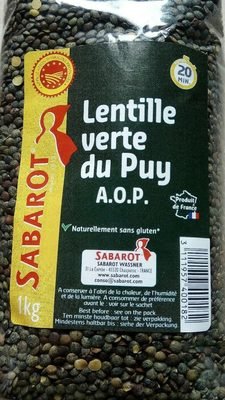
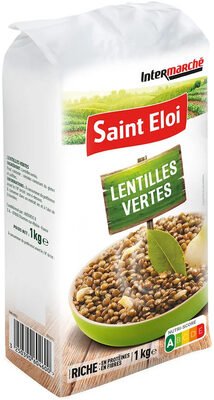
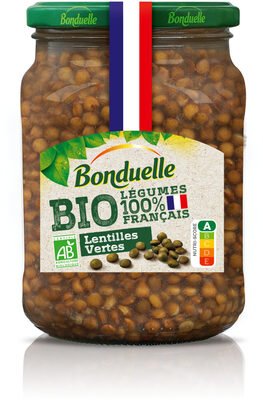
Lustucru’s pre-cooked green lentils (“Lentilles faciles”) also warn of traces of gluten.
Photos and ingredient lists: Open Food Facts, a collaborative open-licence database, retrieved on 16 November 2026. Recipes change: the label on the packet in your hand is what counts.
The table
| No particular risk | To check | Avoid or contains gluten |
|---|---|---|
| Lentils, split peas, beans labelled “gluten free” | Dried pulses with no label: sort and rinse | Mixes with barley, spelt or wheat |
| Dried pulses sorted and rinsed at home | Plain tinned pulses: the traces line | Ready meals with wheat flour or wheat-based stock |
| Lentil ready meals (stock, sauce) | Pulse flour or pasta with a gluten traces warning | |
| Red lentils and split peas with no label (hard to sort) | Loose pulses |
In short
- Lentils, peas, beans, broad beans: pulses, with no gluten in the plant.
- Wheat and barley grains have been found in bags of lentils; 4 of 17 lentil products exceeded 20 mg/kg in an Italian study.
- No “gluten free” label: sort, then rinse. That doesn’t work for pulse flours and lentil pasta.
- Tins and ready meals: read the traces line and the stock.
One bag of lentils with no label, another “gluten free”? The Nutrixe scanner reads the claim, the traces line and the ingredient list of ready meals. Discover the app.
To go further: contamination in quinoa, rice and corn, “may contain” warnings, gluten free on a budget and gluten-free vegetarian and vegan eating.
Sources
- Thompson T., Lyons T. B., Keller A., Lentils and Gluten Cross Contact, Frontiers in Nutrition, 2022; 9: 867954: 25 bags of dried lentils from 24 brands sorted by hand, 2 containing cereal grains (one grain of wheat; one grain of wheat and one of barley); no more than 2 intact grains per kilo to stay under 20 mg/kg; advice to sort, then rinse.
- Verma A. K. et al., Gluten Contamination in Naturally or Labeled Gluten-Free Products Marketed in Italy, Nutrients, 2017; 9(2): 115: 4 of 17 lentil products above 20 mg/kg, 0 of 6 for chickpeas and 0 of 7 for kidney beans; inspecting and washing lentils recommended when the pack isn’t labelled gluten free.
- Associazione Italiana Celiachia, L’ABC della dieta del celiaco: plain pulses (fresh, frozen, dried, tinned) allowed; pulse mixes at risk; rare contamination of dried pulses by cereal grains such as barley, dealt with by a visual check, removal of grains and rinsing. Consulted on 16 November 2026.
- AFDIAG, Lors de vos achats en magasin: pulses among naturally gluten-free foods; rice and lentils may be contaminated during transport or storage and should be rinsed well; traces warnings and loose buying advised against. Consulted on 16 November 2026.
- Coeliac UK, A guide to grains, November 2024: pulses (peas, beans, lentils) and their flours among foods suitable for a gluten-free diet.
- Commission Implementing Regulation (EU) No 828/2014: the “gluten-free” claim is reserved for foods containing no more than 20 mg/kg of gluten.
- Open Food Facts, product entries 3111957400182 (Sabarot Puy lentils), 3250390604600 (Saint Eloi green lentils), 3083681096910 (Bonduelle organic lentils), 3038359004865 (Lustucru Lentilles faciles), 3564700009970 (Marque Repère petit salé aux lentilles), 3250390787266 (Monique Ranou petit salé aux lentilles) and 3478820023757 (Jardin Bio lentils with vegetables), consulted on 16 November 2026.
This information is no substitute for medical advice. How strict you need to be depends on your situation: if you have coeliac disease, talk to your doctor or to a patient association such as Coeliac UK or, in the US, the Celiac Disease Foundation.