Nutrixe
Chestnut flour has no gluten by nature: it is the fruit of the chestnut tree, dried and ground. But packs don’t all say the same thing, from a manufacturer’s “gluten free” to possible traces of gluten, and in Corsica as elsewhere, many breads, biscuits and fritters “with chestnut” are made with wheat flour.
A fruit, not a cereal
Chestnuts grow on a tree. Their proteins have nothing in common with those of wheat, barley and rye. Coeliac UK lists chestnut, ground into flour, among foods suitable for a gluten-free diet; you’ll find it in our list of foods with and without gluten, alongside teff and cassava.
It has its home regions:
- Corsica, with a protected designation of origin, Farine de châtaigne corse – Farina castagnina corsa. INAO, the French body that manages designations, names pulenda (a chestnut-flour polenta) and fritters among its signature dishes.
- The Ardèche and the Cévennes in southern France, where chestnuts are sold dried, as a spread and as flour.
- Tuscany, with castagnaccio, a flat cake of chestnut flour, water, olive oil, pine nuts, raisins and rosemary, and necci, chestnut-flour pancakes. Our guide to gluten-free Tuscany covers the rest of the table.
What’s still at risk
The mill
Like any flour, chestnut flour keeps the dust of its mill. Coeliac UK points out that some flours are milled in the same place as wheat, barley or rye, and that a “may contain” warning for cereals containing gluten should rule a product out. The Italian coeliac association (AIC) classes chestnut flour as an “at risk” food, to be bought only with the “gluten free” label. The mechanism, from field to mill, is explained in our article on contamination in quinoa, rice and corn.
PDO says nothing about gluten
The Corsican designation guarantees an origin, local varieties and a method: INAO mentions a mill fitted with two millstones. It sets no gluten limit. The only figure-backed promise is the “gluten free” claim, which Commission Implementing Regulation (EU) No 828/2014 reserves for products with 20 mg/kg at most. A PDO flour without that claim is read like any other.
Wheat in “chestnut” recipes
Without gluten, dough can’t hold the gases of fermentation: chestnut flour alone won’t make bread rise. Bakers and biscuit makers therefore usually mix it with wheat flour. Chestnut bread, canistrelli, fritters, pancakes, cakes: the chestnut is in the name, the wheat is often in the list, sometimes first, as on the canistrelli bag below. At a market or a farm, with no label, ask for the recipe.
Gluten-free chestnut breads do exist, but they combine other gluten-free flours, usually rice or buckwheat, and come from kitchens that don’t use wheat. In Paris, one fully gluten-free bakery in our selection bakes with rice, buckwheat and chestnut: see gluten-free bakeries in France.
Three bags, three answers
These products were recorded in France.
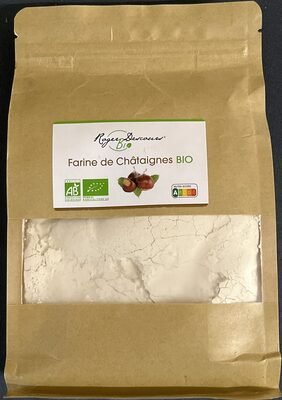
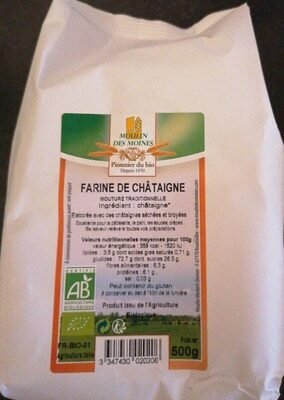
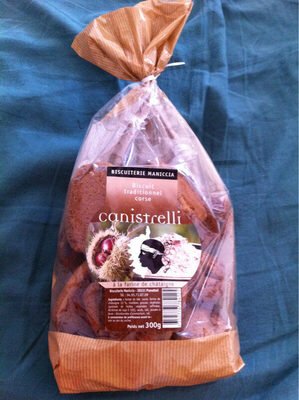
Four other chestnut flours recorded the same day, from Priméal, Celnat, Clément Faugier and Roger Descours (its Ardèche flour), show neither a “gluten free” claim nor a traces warning on their Open Food Facts entry, and their ingredient list is a single word. The scanner doesn’t draw a conclusion: “Check the pack”. For a coeliac, the “gluten free” claim is what to look for on the bag.
Photos and ingredient lists: Open Food Facts, a collaborative open-licence database, retrieved on 16 November 2026. Recipes change: the label on the packet in your hand is what counts.
The table
| No particular risk | To check | Avoid or contains gluten |
|---|---|---|
| Chestnut flour labelled “gluten free” or with the Crossed Grain | Chestnut flour with no label, PDO included | Flour with a gluten traces warning |
| Whole chestnuts, plain | Castagnaccio, pulenda, necci in restaurants (which flour) | Bread, canistrelli, fritters “with chestnut” made with wheat flour |
| Chestnut spread and marrons glacés (ingredient list) | Loose or unlabelled chestnut flour |
In short
- The chestnut is a fruit: no gluten in the flour itself.
- The risk is the mill: Moulin des Moines warns of traces, other bags say nothing.
- PDO guarantees origin, not the absence of gluten.
- Bread, biscuits, fritters “with chestnut”: wheat flour is often in the list.
“With chestnut flour”, but with what else? The Nutrixe scanner reads the whole list, traces line included. Discover the app.
For other wheat-free flours: chickpea flour, almond flour, buckwheat, what each logo is worth and “may contain” warnings.
Sources
- Coeliac UK, A guide to grains, November 2024: chestnut, ground and used for flour, among foods suitable for a gluten-free diet; some flours may be milled in the same place as wheat, barley or rye; avoid products with a “may contain” warning for cereals containing gluten.
- Associazione Italiana Celiachia, L’ABC della dieta del celiaco: chestnut flour (“farina di castagne”) among at-risk foods, to be chosen with the “senza glutine” label. Consulted on 16 November 2026.
- INAO, Farine de châtaigne corse – Farina castagnina corsa: PDO recognised in 2010, local varieties, mill with two millstones, signature dishes (fritters, pulenda). Consulted on 16 November 2026.
- Commission Implementing Regulation (EU) No 828/2014: the “gluten-free” claim is reserved for foods containing no more than 20 mg/kg of gluten.
- Open Food Facts, product entries 3558370000078 (Roger Descours organic chestnut flour), 3347430020206 (Moulin des Moines chestnut flour), 3352776784125 (Biscuiterie Maniccia canistrelli), 3380380062100 (Priméal), 3273120011776 (Celnat), 0022314018373 (Clément Faugier) and 3558370001389 (Roger Descours, Ardèche chestnut flour), consulted on 16 November 2026.
This information is no substitute for medical advice. How strict you need to be depends on your situation: if you have coeliac disease, talk to your doctor or to a patient association such as Coeliac UK or, in the US, the Celiac Disease Foundation.