Nutrixe
No, gelatin doesn’t contain gluten: it’s an animal protein, made from bones and skins, with no cereal at all. The gelatin sheets and powder in the baking aisle have a single ingredient. When there is gluten, it comes from somewhere else: the flour, the starch or the factory of the gummy sweets that contain it.
What gelatin is
Gelatin is made by slowly cooking down materials rich in collagen. The EU regulation on hygiene for food of animal origin (853/2004) lists what may be used to make food gelatin: bones, hides of farmed ruminants, pig skins, poultry skin, tendons, wild game hides, and fish skin and bones. No cereal, and no step where one is added.
It’s sold in two forms, which are the same gelatin:
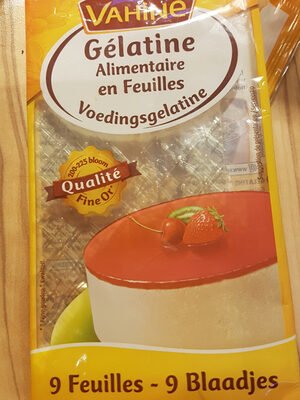
- Sheets (leaf gelatin), softened in cold water and then dissolved in a hot mixture (bavarois, panna cotta, mousse cakes).
- Powder, which disperses directly.
Pork, beef or fish: the animal makes no difference to gluten. It matters for religious or vegetarian reasons, and for fish allergy. The EU food information regulation (1169/2011) actually exempts from the “fish” allergen labelling fish gelatin used as a carrier for vitamins or as a fining agent in wine and beer: someone allergic to fish won’t always see it written down.
Two supermarket gelatins

Powdered gelatin from Auchan and from Sainte Lucie, both sold in France, read the same way: a single ingredient, pork gelatin.
A single ingredient doesn’t excuse you from reading the traces line. In Spain, Royal’s plain powdered gelatin says “Puede contener trigo y leche” (may contain wheat and milk): that’s the factory talking, not the gelatin, and the scanner shows “May contain traces of gluten”.
Gummy sweets: the gluten comes from elsewhere
Bears, strawberries, cola bottles: many gummy sweets are set with gelatin, others with pectin, gum arabic or starch. Gelatin adds no gluten, but it’s never alone. Three ingredients change the answer.
Wheat flour
You find it in strip or tube sweets, such as Lutti’s Scoubidou and Long Fizz, and in liquorice. Liquorice root has no gluten; Haribo’s liquorice wheels (Lakritz Schnecken) and its Cocobat rolls, on the other hand, contain wheat flour. The Nutrixe scanner doesn’t stop at the word “liquorice”: it looks for the flour that comes with it.
Starch of unstated origin
You find it, for example, in sugar-coated sweets and in marshmallows. In Europe, an ingredient derived from wheat has to be named with the word “wheat”, emphasised (Regulation 1169/2011, Article 21). But as long as the origin isn’t written, nothing can be deduced, and the scanner answers “Check the pack”. Modified starch works the same way.
Wheat glucose syrup
It’s the most common ingredient in sweets, and it isn’t the problem: wheat-based glucose syrup is exempt from allergen labelling, because it’s refined to the point of no longer containing gluten. Our article on maltodextrin and glucose syrup explains why.
Three bags, three answers
These three bags are sold in France.


The last bag shows the most common trap: “gelatin free” doesn’t mean “gluten free”. Scoubidou has no gelatin, but it has wheat flour. And at Haribo, Tagada’s recipe has no cereal, but Haribo France warns of possible wheat traces: our comparison of Haribo, Kinder and Nutella covers the brand country by country. Traces warnings are read as explained in our article on “may contain” warnings.
Photos and ingredient lists: Open Food Facts, a collaborative open-licence database, retrieved on 16 November 2026. Recipes change: the label on the packet in your hand is what counts.
Agar, the plant-based alternative
Agar (E406) is extracted from red seaweed, according to the European Food Safety Authority (EFSA). It has no connection with cereals. It gives a firmer set than gelatin and has to be boiled to set. Vahiné’s powdered agar, whose list says only “gelling agent: agar (E406)”, comes out as “No gluten in the ingredients”. Pectin, from fruit, plays the same role in jams and many vegetarian sweets.
The table
| No particular risk | To check | Contains gluten |
|---|---|---|
| Gelatin sheets or powder, single ingredient, no traces warning | Gelatin with a wheat traces warning (Royal in Spain) | Strip or tube sweets made with wheat flour |
| Agar, pectin | Sweets and marshmallows with “starch” of unstated origin | Liquorice sticks, rolls or wheels made with wheat flour |
| Gummy sweets labelled “gluten free” | Gummy sweets with no claim at all | |
| Sweets with a wheat traces warning (Tagada in France) | ||
| Ready-made flavoured jellies: read the list |
In short
- Gelatin is an animal protein: no cereal, whatever the animal.
- Sheets or powder: same gelatin, one ingredient. Still read the traces line.
- In sweets, gluten comes from wheat flour, starch of unstated origin or the factory.
- Gelatin free ≠ gluten free: vegetarian Scoubidou contains wheat.
- Agar (seaweed) replaces gelatin without adding gluten.
One bag of sweets, thirty ingredients? The Nutrixe scanner reads the list for you and shows you what it found: wheat flour, starch of unstated origin, traces warning. Discover the app.
See also: glucose syrup and maltodextrin, modified starch, ice cream and eating gluten free and vegetarian.
Sources
- Regulation (EC) No 853/2004, Annex III, Section XIV, Chapter I: raw materials authorised for food gelatin (bones, hides of farmed ruminants, pig skins, poultry skin, tendons, wild game hides, fish skin and bones).
- Regulation (EU) No 1169/2011, Article 21 (allergenic ingredients named and emphasised) and Annex II: wheat-based glucose syrups exempt; fish gelatin used as a carrier for vitamins or as a fining agent in beer and wine exempt.
- EFSA, Re-evaluation of agar (E 406) as a food additive, EFSA Journal, 2016: agar extracted from marine algae of the Gelidiaceae and Gracilariaceae families (red seaweed).
- Haribo France, Tagada: “Peut contenir des traces de blé” (may contain traces of wheat). Consulted on 2 November 2026.
- AFDIAG, Lors de vos achats en magasin, afdiag.fr: products with a “may contain traces of…” warning advised against.
- Open Food Facts, product entries 3179141394051 (Vahiné, leaf gelatin), 3179142056583 (Vahiné, organic gelatin), 4000521741020 (Dr. Oetker, gelatin), 3596710366279 (Auchan, gelatin), 3162050016015 (Sainte Lucie, gelatin), 3116740033875 (Lutti, Bubblizz), 3664346303149 (La Pie qui Chante, Gom’s), 3116740027317 (Lutti, Scoubidou), 3103220044544 (Haribo, Tagada), 3116740030393 (Lutti, Long Fizz), 4001686101148 (Haribo, Lakritz Schnecken), 3103220059722 (Haribo, Cocobat), 8410000005172 (Royal, plain gelatin, Spain) and 3179142054428 (Vahiné, agar), consulted on 16 November 2026.
This information is no substitute for medical advice. How strict you need to be depends on your situation: if you have coeliac disease, talk to your doctor or to a patient association such as Coeliac UK.