Nutrixe
No, xanthan gum, guar gum, locust bean gum and psyllium husk don’t contain gluten: the first is made by a bacterium, the other three come from seeds unrelated to wheat. In fact, they are what replaces gluten in gluten-free bread. But their presence says nothing about the rest of the recipe: an ordinary wheat sandwich loaf can contain xanthan gum too.
Why they’re everywhere in gluten-free food
In a wheat dough, gluten forms an elastic network that traps the gas from the yeast and gives bread its crumb. Without it, a dough of rice or maize flour falls apart. Manufacturers therefore add thickeners that hold water and bind the dough. Coeliac UK sums it up for xanthan gum: it enhances structure and consistency, and can be used at home in gluten-free baking as a substitute for gluten.
Our article on gluten-free bread shows these ingredients on Schär and Gerblé labels, often next to hydroxypropyl methylcellulose (E464), a modified cellulose that plays the same role.
Where each thickener comes from
Xanthan gum (E415)
It is made by fermentation. According to the European Food Safety Authority’s re-evaluation (EFSA, 2017), a bacterium, Xanthomonas campestris (found naturally on cabbages), is grown in a medium containing a nitrogen source, minerals and sugars such as glucose or sucrose. The gum is then separated from the bacteria, precipitated with alcohol, dried and milled.
The growth-medium question. Industrial glucose can come from maize, wheat or other plants, and EFSA does not say which; its opinion does not mention gluten. Two facts help:
- in Europe, wheat-based glucose syrup is exempt from allergen labelling, because it is refined to the point of no longer containing gluten (Regulation 1169/2011, Annex II): our article on glucose syrup and maltodextrin explains why;
- the gum is then purified. The EU specification limits residual nitrogen to 1.5%, and in its 2023 follow-up opinion EFSA checked that samples supplied by industry met it. The opinion does not say which proteins that nitrogen comes from.
We found no public data measuring gluten in xanthan gum. And certified gluten-free xanthan gums exist, which means they are tested below 20 mg/kg, like the Freee one below.
Guar gum (E412)
It is the ground endosperm of the seeds of the guar plant (Cyamopsis tetragonoloba), a member of the legume family, according to EFSA. No cereal, so no gluten. EFSA notes that it contains a little guar protein (5 to 6%) and that a few allergy cases have been reported, mostly in workers who breathe it in: a different question from coeliac disease.
Locust bean gum (E410)
Also sold as carob gum, and called “carob seed flour” on French and German labels, which is misleading: it is the ground endosperm of the seeds of the carob tree (Ceratonia siliqua), another legume, according to EFSA. Nothing to do with a cereal flour. The Nutrixe scanner doesn’t mistake it for wheat, not even under its German name, Johannisbrotkernmehl, which hides the word Brot (bread).
Psyllium husk
Psyllium is not an additive but a fibre: the husk, or seed coat, of a plantain, Plantago ovata. In contact with water it forms a gel-like mass, according to the European Medicines Agency’s monograph, which also covers its use as a mild laxative. That gel is what gives gluten-free bread its hold.
Four labels
These products are sold in France.

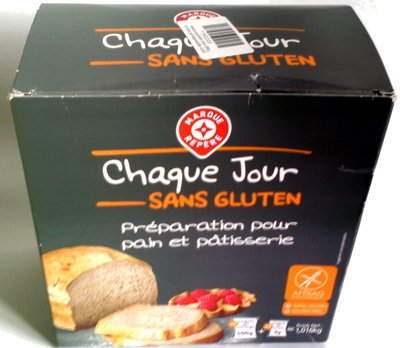
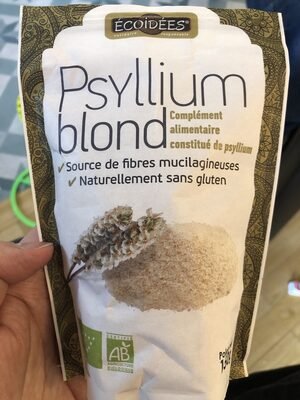
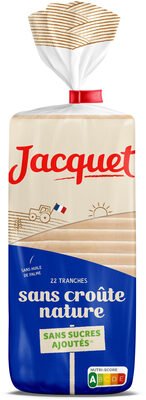
The last packet is the reason for this article: xanthan gum is in gluten-free bread, but also in many ordinary sandwich loaves, alongside wheat flour. Seeing it in an ingredient list doesn’t mean a product is gluten free.
Photos and ingredient lists: Open Food Facts, a collaborative open-licence database, retrieved on 16 November 2026. Recipes change: the label on the packet in your hand is what counts.
The table
| Gluten free (check for traces) | To check | Contains gluten |
|---|---|---|
| Xanthan gum, guar gum, locust bean gum, psyllium: no cereal | Packets of gum or psyllium with no claim at all | Breads and biscuits where the gum sits next to wheat flour |
| Certified xanthan gum (Freee) | Flour mixes with no “gluten free” claim | |
| Flour mixes labelled “gluten free” or with the Crossed Grain | Any gluten traces warning on the packet |
In short
- E415 (xanthan) comes from a bacterium, E412 (guar) and E410 (locust bean) from legume seeds, psyllium from a plantain.
- None contains gluten; they are what replaces it in gluten-free bread.
- The glucose that feeds the bacterium may come from wheat, but it is refined to the point of being exempt from allergen labelling, and certified gums exist.
- Their presence does not make a product gluten free: Jacquet’s sandwich loaf has both xanthan gum and wheat.
Xanthan gum, E412, locust bean gum? The Nutrixe scanner recognises these thickeners for what they are, and looks for wheat where it really is. Discover the app.
For gluten-free cooking: almond flour, baking powder, gluten-free wheat starch and gelatin.
Sources
- EFSA, Re-evaluation of xanthan gum (E 415) as a food additive, EFSA Journal, 2017 (full text): produced by fermentation with Xanthomonas campestris in a medium containing a nitrogen source, minerals and carbohydrates such as glucose and sucrose, precipitated with ethanol or propan-2-ol; no safety concern for the general population, abdominal discomfort in some individuals at high intakes. Consulted on 16 November 2026.
- EFSA, Re-evaluation of xanthan gum (E 415) … and follow-up of its re-evaluation, EFSA Journal, 2023 (full text): samples within the EU limit of 1.5% nitrogen; no data on residual proteins measured as such. Consulted on 16 November 2026.
- EFSA, Re-evaluation of guar gum (E 412) as a food additive, EFSA Journal, 2017: ground endosperm of the seeds of Cyamopsis tetragonoloba (legumes), 5–6% crude protein.
- EFSA, Re-evaluation of locust bean gum (E 410) as a food additive, EFSA Journal, 2017: ground endosperm of the seeds of the carob tree, Ceratonia siliqua (legumes).
- European Medicines Agency, Plantaginis ovatae seminis tegumentum: seed coat of Plantago ovata, a fibre that forms a gel-like mass with water. Consulted on 16 November 2026.
- Coeliac UK, Channel 5’s “Secrets of Your Supermarket Food” and media this week, 5 March 2019: xanthan gum enhances structure and consistency, and can be used at home in gluten-free baking as a substitute for gluten. Consulted on 16 November 2026.
- Regulation (EU) No 1169/2011, Annex II: wheat-based glucose syrups exempt from allergen labelling.
- Commission Implementing Regulation (EU) No 828/2014: the “gluten-free” claim is reserved for foods containing no more than 20 mg/kg of gluten.
- Open Food Facts, product entries 5011766222440 (Freee, Xanthan Gum), 3564700653616 (Marque Repère, Chaque Jour Sans Gluten, bread and pastry mix), 3760087364200 (Ecoidées, psyllium husk), 3029330068549 (Jacquet, crustless sandwich bread), 8008698004807 (Schär, Mix Pain) and 3760130560955 (Mon Fournil, gluten-free flour mix), consulted on 16 November 2026.
This information is no substitute for medical advice. How strict you need to be depends on your situation: if you have coeliac disease, talk to your doctor or to a patient association such as Coeliac UK.