Nutrixe
Yes, plain peanut butter is gluten free: it’s made from roasted peanuts, sometimes with salt, oil or sugar. But some jars carry a traces of wheat gluten warning linked to the factory, and versions with biscuit or cereal contain gluten: the bottom line of the label settles it.
Why peanuts have no gluten
The gluten that causes problems for coeliacs is a group of proteins found in wheat, barley and rye. The peanut, or groundnut, is a legume, from the same family as peas, lentils and soya: its proteins have nothing in common with them. Coeliac UK, for its part, counts nuts and seeds among naturally gluten-free foods.
The peanut is, however, a major allergen, which European Regulation No 1169/2011 lists separately from tree nuts. That has nothing to do with gluten: a coeliac person can eat peanuts, a person with a peanut allergy can’t.
What’s still at risk
Factory traces
Facilities that grind peanuts often handle other products too: tree nuts, seeds, spreads, sometimes biscuits or cereals. When the manufacturer can’t rule out contact, it says so. AFDIAG, the French coeliac association, advises avoiding these products when in doubt. These warnings are voluntary: their absence doesn’t prove the line is controlled; only a “gluten free” label commits the manufacturer.
Enriched recipes
Crunchy peanut butter with biscuit pieces, spreads with crispy cereal, peanut butter bars and bites: as soon as a crunchy ingredient is added, it may be made from wheat or barley malt.
Loose produce and in-store grinders
Some health food shops let you grind your own peanut butter in a self-service grinder, next to the loose bins. AFDIAG advises against buying loose, and a shared grinder offers no guarantee about what went through it before.
On the plate
Satay sauce and Asian peanut dishes are often seasoned with soy sauce, which is brewed with wheat: our article on soy sauce and tamari covers this trap. And at home, a knife that goes from the slice of bread to the jar leaves crumbs behind: a dedicated jar settles the question, as explained in our article on cross-contamination at home.
Two jars, two answers
These two products are sold in France.

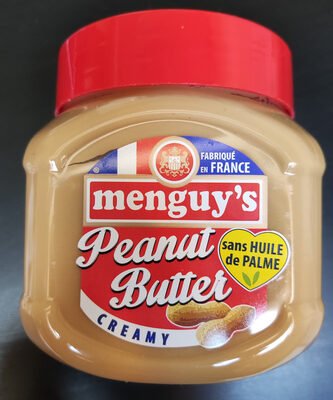
According to Open Food Facts, the same gluten traces warning appears on the same brand’s “Peanut 100%”, whose only ingredient is peanuts. So it isn’t the recipe that’s at fault, but the factory.
Photos and ingredient lists: Open Food Facts, a collaborative open-licence database, retrieved on 8 October 2026. Recipes change: the label on the jar in your hand is what counts.
The table
| No particular risk | To check | Avoid or contains gluten |
|---|---|---|
| Peanut butter labelled “gluten free” | Peanut butter with no label at all | Jar with a gluten traces warning |
| Plain peanuts, ground at home | Peanut spreads | Versions with biscuit, cereal or malt |
| Satay sauce (soy sauce) | Butter ground in a self-service grinder |
How to choose
- Read the ingredients list: on a plain peanut butter, it fits on one line. Any crunchy addition needs checking.
- Read the traces line. A gluten warning rules the jar out; see our article on “may contain” warnings.
- The “gluten free” label, governed by Commission Implementing Regulation (EU) No 828/2014, guarantees no more than 20 mg/kg. It’s still rare on this product in France.
- A dedicated jar at home, if the rest of the family eats ordinary bread.
In short
- The peanut is a legume: it contains no gluten.
- Plain peanut butter has no gluten-containing ingredient, but some jars warn of traces of wheat gluten.
- Versions with biscuit, cereal or malt contain gluten.
- For a coeliac: a short ingredients list, no gluten traces warning, a dedicated jar.
Not sure about a jar? The Nutrixe scanner reads the ingredients list and the traces warning, and never tells you “gluten free” without proof. Discover the app.
See also: crisps and snacks, chocolate and sweets, and the list of foods with and without gluten.
Sources
- Regulation (EU) No 1169/2011 on the provision of food information to consumers, Annex II: cereals containing gluten, peanuts and tree nuts counted as separate allergens.
- Commission Implementing Regulation (EU) No 828/2014 of 30 July 2014: the “gluten-free” claim is reserved for foods containing no more than 20 mg/kg.
- AFDIAG, Lors de vos achats en magasin, afdiag.fr: products with a “may contain traces of…” warning and loose buying advised against.
- Coeliac UK, Coeliac disease and the gluten free diet (presentation for healthcare professionals, 2022): nuts and seeds among naturally gluten-free foods.
- Open Food Facts, product entries 5013665115571 (Whole Earth Beurre de cacahuètes), 3327272107259 (Menguy’s Creamy) and 3327272107969 (Menguy’s Peanut 100 %), consulted on 8 October 2026.
This information is no substitute for medical advice. How strict you need to be depends on your situation: if you have coeliac disease, talk to your doctor or to a patient association such as Coeliac UK or, in the US, the Celiac Disease Foundation.