Nutrixe
Miso is not always gluten free: it is made from soybeans, salt and a rice, barley or soybean koji, and barley miso (“mugi miso”) contains gluten. Tempeh and natto, in their classic recipes, are fermented soybeans with no cereal. The risk comes from what is added: mixed grains, a soy sauce marinade, a sauce sachet, or traces from the factory.
What miso is
Miso is a salted, fermented soybean paste, matured with a koji: a grain or soybeans inoculated with a mould, Aspergillus oryzae. The koji is what defines the type of miso. A 2019 Japanese study lists four types, with their 2017 market shares as reported by the Japan Federation of Miso Manufacturers Cooperatives:
- rice miso (kome miso), 81% of the Japanese market;
- barley miso (mugi miso), 4%;
- soybean miso (mame miso, including hatcho miso), 5%;
- blended miso (awase), combining several types, 10%.
Barley miso contains gluten, as does barley itself. Blended miso may contain it. “White” (shiro) or “red” (aka) describe the colour, not the grain: only the ingredients list gives it. Genmai miso is a brown rice miso.
What the associations say
AIC, the Italian coeliac association, classes miso, along with tamari and soy sauce, as “at risk” foods: their gluten content depends on the product, and the label decides. FACE in Spain lists miso and tempeh among “conventional” products, which may come into contact with gluten and whose labels need reading.
In the European Union, an ingredients list must name barley, whatever Japanese word is printed next to it (Regulation No 1169/2011). That matters, because the Nutrixe scanner reads “barley”, “orge”, “Gerste”, “orzo”, “cebada” and “cevada”, but not “mugi” on its own: on an imported jar that only says that word, it is up to you to spot it.
Three misos from the shelf
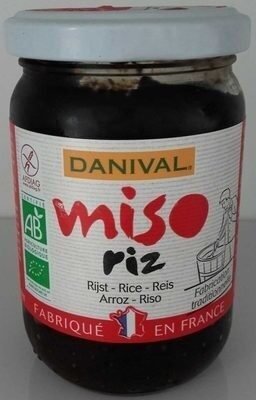
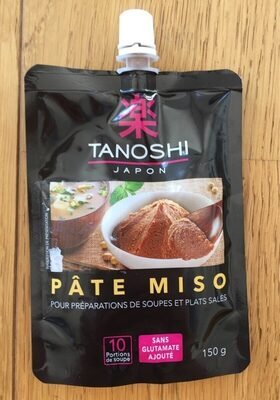
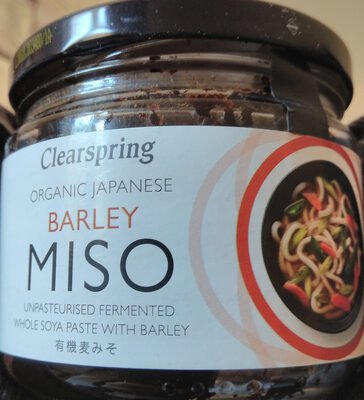
Danival also makes a white miso, from rice, with the Crossed Grain, and a barley miso, which contains gluten. Hikari’s Aka Miso paste (water, soybeans, rice, salt) and Clearspring’s brown rice miso get “No gluten in the ingredients”.
Miso soup
Miso soup is miso dissolved in a stock. Its answer is therefore that of its miso, plus that of its stock and toppings. Danival’s Miso Cube Original, a stock cube for soup, contains barley miso: “Contains gluten”. In a Japanese restaurant, ask which miso is used: our article on sushi and Japanese food lists miso soup among the dishes to check, and our guide to gluten-free travel in Japan gives useful phrases. Miso ramen, for their part, are made with wheat noodles, as explained in our article on Chinese and Asian food.
Tempeh
Tempeh is made from soaked, cooked soybeans inoculated with a mould of the genus Rhizopus, whose mycelium binds the beans into a firm cake. Plain tempeh has no gluten cereal in its recipe. Three things still need checking:
- Grains. Tempeh can also be made from other legumes or from grains: researchers have produced it from wheat and triticale.
- Marinade. Smoked or marinated tempeh may be seasoned with soy sauce, which often contains wheat: our article on soy sauce and tamari explains the difference.
- The factory. Some tempeh sold in France carries a gluten traces warning, like this one.
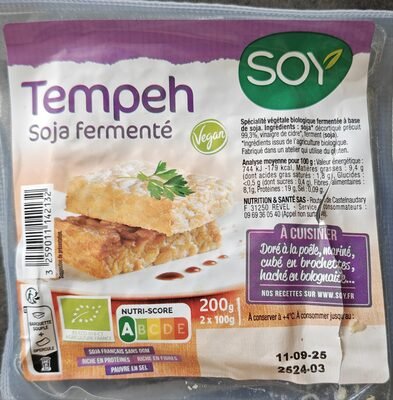
Lima’s plain tempeh (soybeans, water, apple vinegar, live ferment Rhizopus oligosporus) carries no traces warning: “No gluten in the ingredients”.
Photos and ingredient lists: Open Food Facts, a collaborative open-licence database, retrieved on 16 November 2026. Recipes change: the label on the product in your hand is what counts.
Natto
Natto is soybeans fermented by a bacterium, Bacillus subtilis var. natto. The beans contain no cereal. But Japanese natto packs often come with two sachets, sauce and mustard. On the kotsubu natto we checked in the UK, the sauce sachet contains soy sauce made with wheat: “Contains gluten”. The seasoning supplied makes the difference: natto sold with a wheat-based soy sauce sachet is not a gluten-free product.
The table
| No gluten in the recipe (check for traces) | To check | Contains gluten |
|---|---|---|
| Rice, brown rice or soybean miso, list read | Miso with no koji stated, blended miso (awase) | Barley miso (mugi miso) |
| Plain soybean tempeh | Marinated or smoked tempeh, mixed-legume tempeh | Tempeh made from gluten grains |
| Natto beans | Miso soup in restaurants, seasoning sachets | Miso ramen, wheat-based soy sauce sachet |
For tofu, the other soy staple, see our article on tofu, and for traces, our guide to “may contain” warnings.
In short
- Miso is defined by its koji: rice and soybeans have no gluten cereal, barley does.
- “White” or “red” say nothing about the grain: read the list, where barley must be named.
- Tempeh: soybeans only in principle, but marinades, grains and factories need checking.
- Natto: no cereal in the beans, but often wheat in the sauce sachet.
A jar of miso from Japan? The Nutrixe scanner reads barley and wheat in six languages, from the ingredients list to the traces, and tells you what it found. Discover the app.
Further reading: gluten-free vegetarian and vegan eating, rice and vinegar.
Sources
- Kojo T. et al., Effect of Maturation Time on Koji-like Smell and Volatile Compounds of Barley Miso (Japanese Soybean Paste) during Fermentation, Food Science and Technology Research, 2019; 25(2): 313–319: four types of miso by koji (rice, barley, soybean, blended) and their 2017 market shares according to the Japan Federation of Miso Manufacturers Cooperatives.
- AIC, L’ABC della dieta del celiaco: miso, tamari and soy sauce among “at risk” foods; soy sauce to be chosen with a “gluten free” label. Consulted on 16 November 2026.
- FACE, Clasificación de los alimentos aptos para personas celiacas: miso, tempeh, tahini and textured soy among “conventional” products whose labels must be checked. Consulted on 16 November 2026.
- Regulation (EU) No 1169/2011, Article 21 and Annex II: barley, a cereal containing gluten, must be named and emphasised in the ingredients list.
- Hachmeister K. A., Fung D. Y. Tempeh: a mold-modified indigenous fermented food made from soybeans and/or cereal grains. Critical Reviews in Microbiology, 1993; 19(3): 137–188: soaked, cooked soybeans inoculated with Rhizopus, bound into a cake by the mycelium; tempeh-like products made from wheat, triticale and sorghum.
- Ahnan-Winarno A. D. et al. Tempeh: A semicentennial review on its health benefits, fermentation, safety, processing, sustainability, and affordability. Comprehensive Reviews in Food Science and Food Safety, 2021; 20(2): 1717–1767: tempeh made from various beans, legumes and grains.
- Open Food Facts, product entries 3431590000441 (Danival rice miso), 3229820799384 (Tanoshi miso paste), 5021554980070 (Clearspring barley miso), 3431590014028 (Danival barley miso), 3431590013526 (Danival white miso), 3431590013854 (Danival Miso Cube Original), 4902663010180 (Hikari Aka Miso), 5021554980056 (Clearspring brown rice miso), 3259011142132 (Soy tempeh), 5411788032155 (Lima plain tempeh) and 4973413347818 (Japan Centre kotsubu natto), consulted on 16 November 2026.
This information is no substitute for medical advice. With coeliac disease, your diet is built with your doctor or a dietitian, and a patient association such as Coeliac UK can support you.