Nutrixe
Foie gras itself doesn’t contain gluten: French regulations limit whole foie gras, foie gras and bloc to the liver, a seasoning and a few additives, with no cereal at all. Gluten comes in through two doors: the stuffing of mousses, médaillons and pâtés, where the law allows flour and starch, and above all the toasts served alongside.
Our article on a gluten-free Christmas and New Year gives the full festive menu. Here, we open the jars.
What the law puts behind each name
In France, the names of foie gras are set by French Decree No. 93-999 of 9 August 1993. Each word on the label matches a precise recipe. These are French legal names, so they appear in French on the jar:
- Foie gras entier (whole foie gras): a whole liver or one or more lobes, and a seasoning.
- Foie gras: pieces of lobes pressed together, and a seasoning.
- Bloc de foie gras: reconstituted foie gras and a seasoning; with morceaux (pieces), these make up at least 30% of the weight.
- Parfait de foie: at least 75% foie gras, topped up with lean liver.
- Médaillon, pâté, galantine or mousse de foie: at least 50% foie gras, with a stuffing.
The seasoning is defined in the same text: salt, sugar, spices and aromatic herbs, spirits, fortified wines and wines. To entier, foie gras and bloc, the decree only allows the addition of truffles, a coating jelly, water (for the bloc), nitrite salt and ascorbic acid. No flour, no starch.
The stuffing, however, can be made of pork, veal or poultry meat, liver, eggs, milk, but also flour and starch (no more than 3% starchy binder). That’s where gluten can get in.
The decree was supplemented in 2000 to accept preparations legally made in another EU country. For an imported product, as for everything else, the ingredient list is what counts.
Port, Armagnac and the jelly
The alcohols in the seasoning are no problem: wine, port and distilled spirits don’t contain gluten, as explained in our article on spirits. The coating jelly is usually made of gelatine, which is gluten free too (gelatine). That leaves, as everywhere, the traces warning, which depends on the factory and not on the recipe: what to do with a “may contain”.
Three labels from the festive aisle
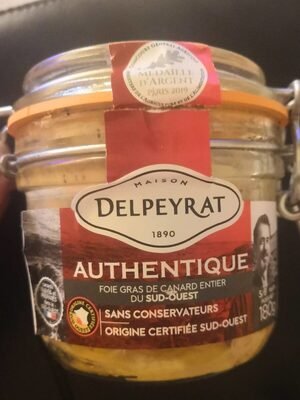
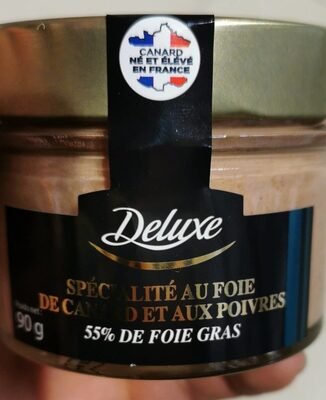
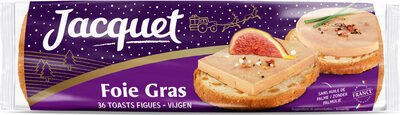
Photos and ingredient lists: Open Food Facts, a collaborative open-licence database, retrieved on 16 November 2026. Recipes change: the label on the product in your hand is what counts.
Where the gluten really hides
Toasts, gingerbread and brioche
Brioche toasts, fig toasts, sliced brioche and gingerbread are foie gras’s companions, and all are made from wheat or rye flour unless labelled “gluten free”. Wheat-free gingerbread is no safer: it’s often made with rye, as explained in our article on rye. For replacement bread, see how to choose gluten-free bread.
The knife and the board
A bloc cut into with the knife that has just sliced the baguette gets covered in crumbs. Serve yourself first, or set aside a jar and a knife: it’s the most ordinary cross-contamination of the festive meal.
Preparations “with foie gras”
Charcuterie products can carry the words au foie de canard (with duck liver) from 20% foie gras: terrines, pâtés en croûte, macarons or puff pastries with foie gras. Those with a crust, a pastry or a stuffing need reading line by line, like charcuterie. Coeliac UK also lists pâtés among the products to check.
At the restaurant
Pan-fried foie gras is sometimes prepared with a slice dusted in flour before searing, and it’s served on a slice of bread or brioche. Ask how it’s cooked and whether it can come without its toast.
The table
| No particular risk | To check | Contains gluten |
|---|---|---|
| Foie gras entier, foie gras, bloc: list with no cereal and no traces warning | Mousse, médaillon, pâté, galantine (stuffing with possible flour or starch) | Brioche toasts, fig toasts, gingerbread not labelled gluten free |
| Raw foie gras to cook yourself | Spécialités and flavoured preparations | Foie gras in a crust, in brioche, in puff pastry |
| Bread or toasts labelled gluten free | Pan-fried foie gras at the restaurant (flour, bread underneath) |
In short
- Entier, foie gras, bloc: the law allows neither flour nor starch.
- Mousse, médaillon, pâté, galantine: a stuffing, where flour and starch are allowed; read the label.
- The gluten on the festive table is the toasts and the gingerbread.
- A separate knife matters as much as the right jar.
A jar of foie gras, a pack of toasts? Scan both: the Nutrixe scanner reads the list and the traces line, and tells you which one is the problem. Discover the app.
See also: a gluten-free Christmas and New Year, Christmas markets, wine, champagne and cider and charcuterie.
Sources
- Décret n° 93-999 du 9 août 1993 relatif aux préparations à base de foie gras (in French), copy of the text published by FAOLEX (FAO): article 2 (names, seasoning, composition of the stuffing: “flour, starch”), articles 3 to 8 (what may be added to each preparation), article 11 (no more than 3% starchy binder in stuffings), article 13 (the words au foie d’oie or au foie de canard from 20% foie gras).
- Décret n° 2000-1245 du 21 décembre 2000 (in French), FAOLEX copy: addition of an article 13-1 for preparations legally made in another Member State.
- Coeliac UK, Gluten free checklist, May 2024: meat and fish pâtés “to check”; products with a “may contain” warning for gluten cereals to be avoided.
- Coeliac UK, Is Alcohol gluten free?: wine, port and spirits gluten free.
- Open Food Facts, product entries 3067163646176 (Delpeyrat, whole foie gras), 3067163621678 (Delpeyrat, bloc), 4056489728207 (Deluxe, duck liver speciality), 3560071181185 (Reflets de France, whole mi-cuit foie gras), 3356650007553 (Panache des Landes, bloc) and 3029330023081 (Jacquet, fig toasts), consulted on 16 November 2026.
This information is no substitute for medical advice. How strict you need to be depends on your situation: if you have coeliac disease, talk to your doctor or to a patient association such as Coeliac UK.